Trade routes that still feel alive
Shaki, caravanserais and old trading towns preserve the atmosphere of routes that once connected the Caucasus with Persia, Central Asia and beyond.


A country where the Caspian meets the Caucasus, where Silk Road towns, ancient rock art, mountain villages and bold contemporary architecture sit within a single journey. Azerbaijan rewards travellers who look beyond Baku and follow the threads of trade, craft, fire, food and landscape that shaped the country.
Azerbaijan stretches from the Caspian shoreline to the foothills of the Greater Caucasus. Its landscapes shift quickly: the wind-shaped Absheron Peninsula, the semi-desert around Gobustan, fertile valleys, forested mountain roads and high villages where the rhythm of life feels far removed from the capital.
Its cultural character is equally layered. Caravanserais, mosques, palaces, copper workshops, carpets, tea culture, regional cooking and a renewed wine scene coexist with Baku’s oil-boom mansions and contemporary skyline. Much of Azerbaijan is understood best through contrast — old trading routes and new architecture, dry plains and green mountains, formality and warm hospitality.
Shaki, caravanserais and old trading towns preserve the atmosphere of routes that once connected the Caucasus with Persia, Central Asia and beyond.
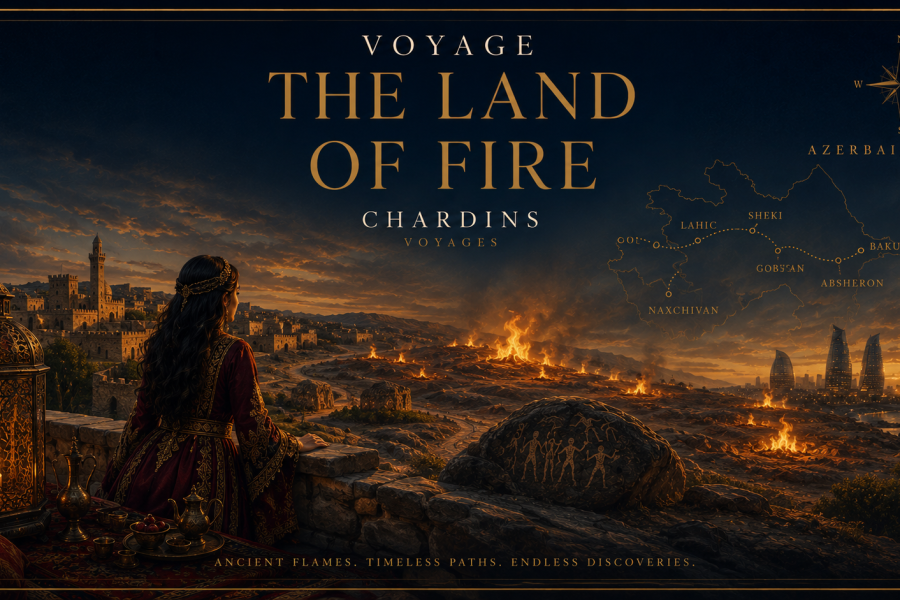
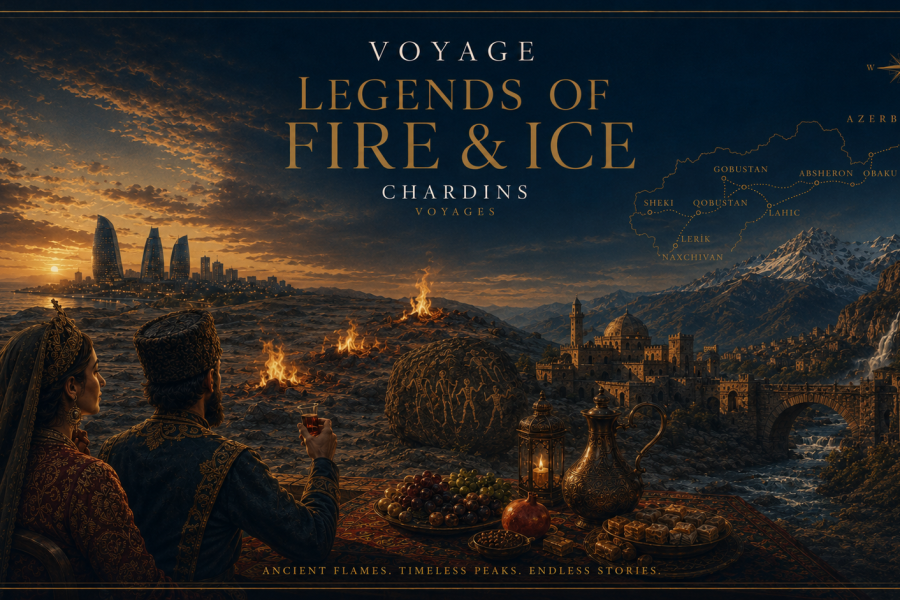
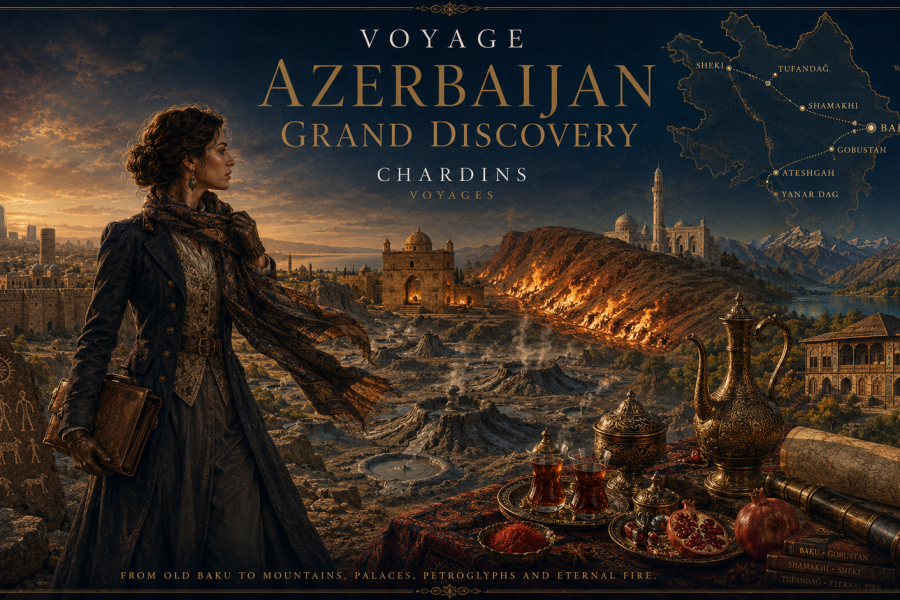
Natural gas flames, mud volcanoes, the Absheron Peninsula and Gobustan’s ancient petroglyphs give the country one of the Caucasus’ most distinctive landscapes.
North of Baku, the Greater Caucasus rises quickly into forested roads, remote settlements and mountain cultures that feel worlds away from the capital.
Shebeke, silk, copperware, carpets, tea and generous regional cooking make Azerbaijani hospitality as tactile as it is memorable.
Azerbaijan’s contrasts are part of its appeal: cosmopolitan Baku, prehistoric Gobustan, Silk Road Shaki and the mountain landscapes of the north can belong to the same itinerary without ever feeling repetitive.
Azerbaijan is most rewarding when the itinerary leaves room for caravanserais, workshops, tea tables, mountain roads and places whose significance only becomes clear with context.
Jean Chardin wrote about Baku and the wider Caspian world during his seventeenth-century travels through the Caucasus and Persia. The roads, borders and empires have changed, but the instinct behind that kind of travel remains relevant: look closely, stay curious, and allow a place to reveal itself through people as much as monuments.
That is how we approach Azerbaijan. Not as Baku plus a handful of excursions, but as a connected landscape in which trade, architecture, craft, food, belief and geography continually overlap.
There is no single “best” month: the right season depends on whether the journey is built around Baku, Silk Road heritage, mountain landscapes, food, wine or a combination of them.
Comfortable temperatures and fresh landscapes make spring one of the easiest seasons for combining Baku, heritage sites and journeys toward the Caucasus.
Long days suit mountain journeys and the Caspian coast, while Baku is at its liveliest; inland lowlands can be hot, so pacing matters.
Warm light, harvest season and cooler temperatures make autumn especially strong for food, wine, Silk Road towns and cross-country travel.
A quieter Azerbaijan, with crisp days in Baku, snow in the mountains and a more intimate atmosphere in historic towns and rural landscapes.
Tell us what draws you here — Baku, Silk Road history, mountain landscapes, food, wine or simply curiosity — and we will shape the journey around it.
Start a Conversation →